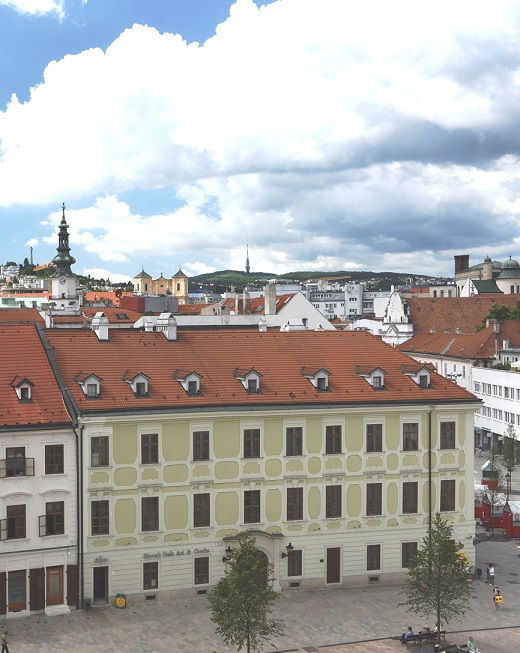
THE OFFICIAL SEAT
Since May 2016, the official seat of the Judicial Council of the Slovak Republic has been the Vice Governor’s Palace on the Main Square in Bratislava. Before its relocation, the Judicial Council was based at the premises of the Supreme Court of the Slovak Republic.
The Vice Governor’s Palace is situated at the corner of the Main Square and Franciscan Square in Bratislava. The building comprises of three above-ground floors, a cellar, and an attic and has an irregular quadrilateral floor plan with two internal atriums.
The Palace is a Baroque building dating from the second half of the 18th century, created by merging two originally separate houses into a single building. The earliest houses on the site were constructed at the turn of the 14th and 15th centuries, as a part of the city’s eastward expansion. The period coincided with a significant influx of German craftsmen and merchants into Pressburg, the historic predecessor of present-day Bratislava. Historical records indicate that the earliest owners and occupants of these houses were wholesale merchants and vineyard owners.
Over the following centuries, the buildings underwent several structural alterations, the most extensive of which were carried out in the 18th century. During the first half of the 18th century, Baron Georg Paluska gradually purchased the various parts of the first house. From 1728, the building appears in historical records as the seat of the Vice Governor’s Council (Consilium haus, Stadthalterey). In the second half of the 18th century, the seat of this Council was expanded by incorporating the adjoining building. The two constructions were merged and extensively reconstructed, giving the Vice Governor’s Palace its present-day form and floor plan. The Palace served as the seat of the Vice Governor’s Council until the late 18th century, when Emperor Joseph II transferred the administrative offices to Buda. Following this relocation, the building became the headquarters of the municipal guard.
In the 19th and early 20th centuries, the Palace accommodated the financial authorities. From the mid-20th century, it became the seat of the Institute for Research on Human Nutrition. Following an extensive restoration in the 1990s, the Vice Governor’s Palace became a dedicated representational facility of the Office of the Government of the Slovak Republic.
Centuries of reconstructions have shaped the palace’s architectural character, which combines Gothic and Renaissance vaults with Baroque architectural elements. The interior rooms were richly decorated with painted ornaments. The main entrance, located on the Main Square is formed by a Baroque columned portal with a semicircular archivolt. The most recent restoration also reinstated the original side entrance from Franciscan Square, which had originally been bricked up. The entrance portal closely resembles the building’s main entrance.
Prepared by the Office of the Slovak Republic based on documentation provided by the Municipal Monument Preservation Institute in Bratislava.